

Introduction
Every three years, the release of the Programme for International Student Assessment (PISA) results generates headlines worldwide, usually centred on a familiar set of questions: Where do we rank? Have our scores gone up or down? How do we compare with other countries?
Conducted by the Organisation for Economic Co-operation and Development (OECD), PISA provides a valuable global benchmark for understanding how 15-year-old students are performing across education systems and how that performance changes over time.
Learn more about PISA in our infographic.
Malaysia’s PISA 2025 performance declined in mathematics, while performance in reading and science remained broadly unchanged from 2022. While some headlines may position the small increases in our reading and science scores as improvement, these changes are not statistically significant and do not indicate a meaningful increase in performance. Therefore, despite heavy investments and continued efforts to transform our education system, we still struggle to translate these inputs into stronger learning outcomes.
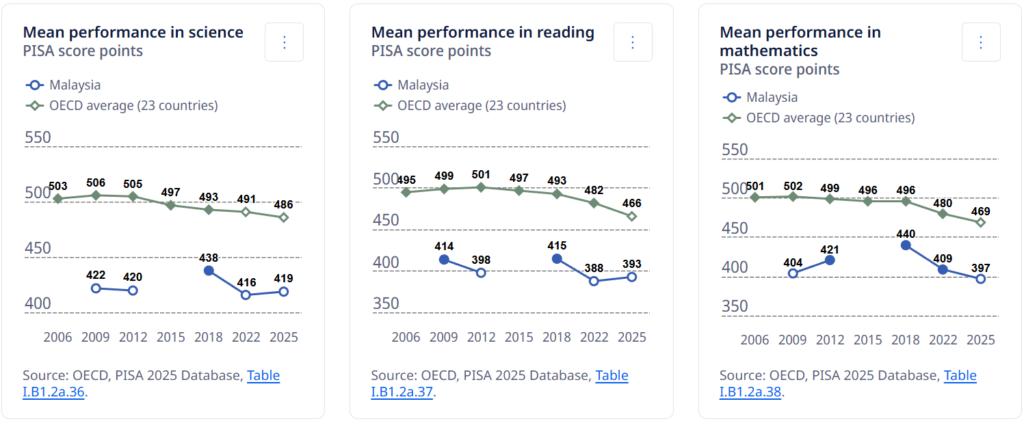
Image Source: PISA Dashboard
Under the Malaysia Education Blueprint 2013 – 2025, the goal was for Malaysia to be in the top third of countries in international assessments. Yet, our latest results show that we remain far from this aspiration. The Rancangan Pendidikan Malaysia 2026 – 2035 (RPM) has since recalibrated the ambition for us to perform on par with the OECD average, a level Malaysia has yet to reach since we participated in PISA.
Beyond knowing how we’re doing and progressing, we must also ask more important questions: what can we learn from these PISA results, and what do we do with what we know? PISA findings enable us to identify common patterns and factors that shape educational outcomes to inform our own education policy and practice. In this piece, we take a closer look at some of the lesser-discussed PISA 2025 findings and what they might tell us about our students, our education system and how learning happens.
Have we raised the floor?
Key Finding #1: More than half of Malaysian 15-year-olds are categorised as low-performing students in reading and mathematics, and nearly half in science
When we examine how students are distributed across different performance levels, a more concerning trend emerges from the PISA results. The proportion of students categorised as low performers (those scoring below Level 2) has either increased or remained relatively stagnant across all three domains since 2018. More than half of Malaysian 15-year-olds remained below baseline proficiency in mathematics and reading, while almost half remained below it in science. Malaysia also has a substantially larger share of low-performing students than the OECD average.
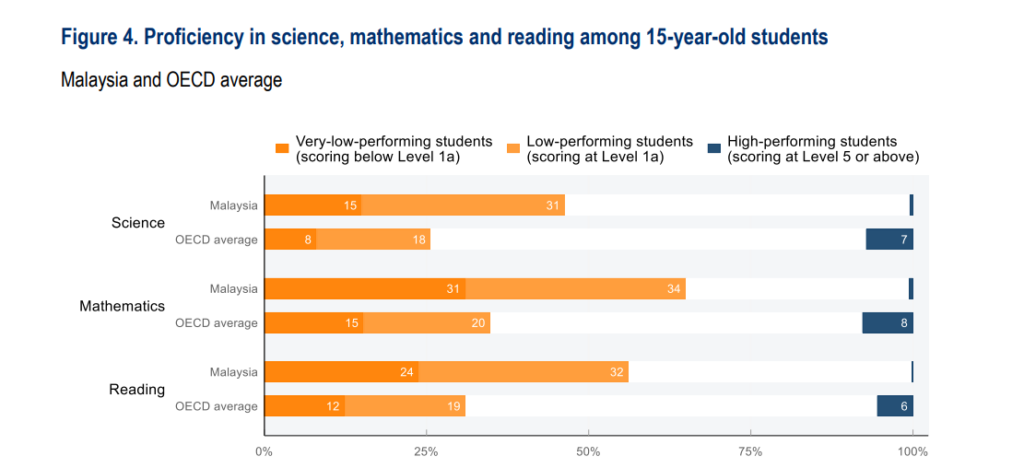
Image Source: PISA 2025 Results (Volume I): Malaysia
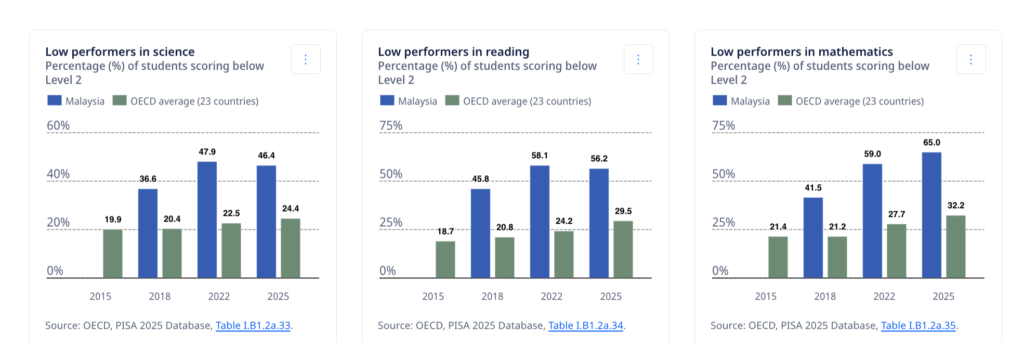
Image Source: PISA Dashboard
In PISA, Level 2 is defined as the “baseline level at which students begin to demonstrate the knowledge and skills needed to participate effectively in society and continue learning”.
What a Level 2 student can do:
| Reading | Identify the main idea and locate information in a moderately long text |
| Mathematics | Recognise and interpret simple real-world situations that are represented mathematically |
| Science | Recognise appropriate explanations for familiar phenomena and draw basic conclusions based on data |
You can try answering PISA test questions here!
When such a large proportion of our students are below baseline proficiency, we need to recognise the reality of the classrooms our teachers are teaching in. Students do not enter classrooms at the same starting point, and many are not at the level the curriculum assumes. This creates a structural challenge for teachers, who are often expected to deliver the existing curriculum while also addressing pre-existing learning gaps within a limited amount of time. The curriculum, teacher training, assessment and classroom practice need to account for both differentiated and low levels of readiness. To raise the floor, we need to design teaching and learning around the learners we actually have, rather than an assumed starting point.
Approaches such as Teaching at the Right Level (TaRL), which groups students by learning level rather than age or grade for foundational skills, offer one example in practice that has been adapted across multiple countries.
Over the past few years, strengthening foundational skills has been a core focus of the Ministry of Education and the government, with remedial programmes such as Program Anak Kita being implemented to address critical literacy and numeracy gaps among students across Malaysia. Other efforts such as Kurikulum Persekolahan 2027, lowering of the school entry age and various initiatives to strengthen preschool education are all steps in the right direction. What we need more of are strong and transparent feedback loops: using data to diagnose where students are struggling, reviewing which interventions are working, and sharing learnings on what does and does not work so we can course-correct with urgency.
Have we raised the ceiling?
Key Finding #2: Less than 1% of Malaysian 15-year-olds are top performers in mathematics and science and almost none in reading
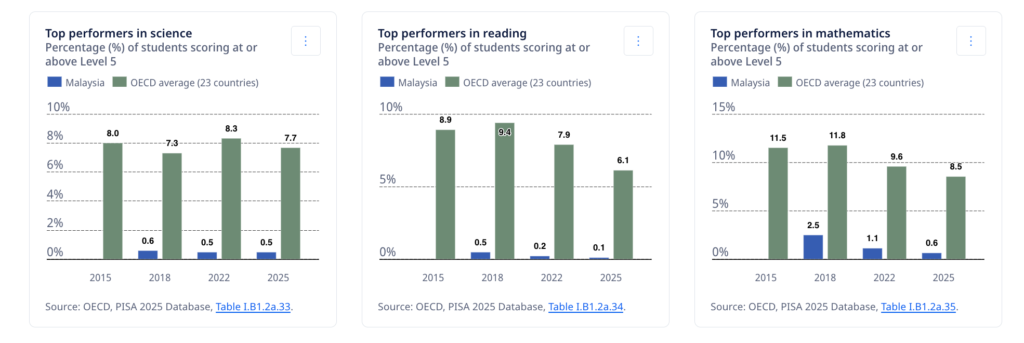
Image Source: PISA Dashboard
In PISA 2025, just 0.6% of Malaysian students reached the highest proficiency levels in mathematics and 0.5% in science, compared with around 8% and 7% respectively across OECD countries. In reading, almost no Malaysian students reached the highest levels, compared with 6% across the OECD. This lack of top performers has been a consistent trend across PISA cycles, raising concerns about our education system’s ability to nurture a pool of high-performing and competitive talent.
As Andreas Schleicher, the Director for Education and Skills in OECD, puts it: “Excellence and equity should not be competing ambitions.” A truly successful education system does not choose between them. The RPM 2026–2035 reflects this dual ambition, with quality alongside access and equity among its key areas of focus. At the same time, the RPM 2026-2035 sets out a number of non-negotiables intended to ensure that every student achieves essential foundations. These are important for raising the floor, but they should not become the ceiling of our ambition. Students need opportunities to be challenged, deepen their knowledge and pursue areas where they show particular aptitude.
This is also reflected in the Rancangan Malaysia Ke-13 (RMK-13), which positions education as a key driver of social mobility and adopts a three-pronged approach to raise the floor, raise the ceiling and strengthen good governance. The quality of the talent pool entering the labour market will shape Malaysia’s ability to meet its longer-term economic and national development ambitions. However, talent development begins long before students enter the workforce. Schooling must be seen and designed as part of a longer-term talent development journey, where potential is identified early and students are given sufficient opportunities to develop their interests and capabilities. While foundational learning must remain a priority, we should not overlook the other end of the spectrum, which is equally worrying. We need to move more students into the highest levels of proficiency and create more pathways for every student to realise their potential, wherever that potential may lead. In doing so, we give students greater agency over their own futures while strengthening the talent pipeline that Malaysia needs.
Did we close the gap?
Key Finding #3: The socioeconomic gap has remained stable — but stable is not the same as progress
In PISA 2025, socioeconomically advantaged Malaysian students (the top 25% in terms of socioeconomic status) outperformed disadvantaged students in science by 82 score points, compared with an average gap of 85 points across OECD countries. The gap has also remained stable in Malaysia between 2018 and 2025, with performance declining to a similar extent among advantaged and disadvantaged students. In a context where socioeconomic gaps have widened in some countries, maintaining the gap rather than seeing it grow is worth recognising.
However, we must also recognise that stability is not the same as progress when everyone is worse off and that the gap still exists. Socioeconomic status accounted for 16% of the variation in Malaysian students’ science performance, compared with 12% across OECD countries. Nevertheless, 10% of disadvantaged Malaysian students performed in the top quarter nationally. These students are considered academically resilient: despite their socioeconomic disadvantage, they still perform well relative to their peers. Therefore, a useful question is what we can learn from students who are beating the odds. Understanding the conditions and experiences that enable some disadvantaged students to thrive could help us identify what schools, teachers and the wider society can do to enable more students to progress, regardless of where they start.
At the same time, we must also be careful about how we interpret “closing the gap” and recognise how that gap is being closed. The pursuit of greater equity should not come at the expense of excellence. The goal should be to raise the bar equitably, raising both the floor and the ceiling so that more students, regardless of background, have the opportunity to reach their potential.
What does PISA tell us about how students learn?
Key Finding #4: Malaysian students are curious, willing to persevere and value learning — but how do we translate these dispositions into learning outcomes?
Beyond the reading, mathematics and science assessments, PISA 2025 also investigates how students approach learning. In this area, there is some encouraging news for Malaysia. 80% of Malaysian students said they are curious about many different things, compared with 73% across the OECD, while 79% said they apply additional effort when work becomes challenging, compared with 60% across the OECD. Just 7% agreed that school has been a waste of time, compared with 24% across the OECD. The findings suggest that many Malaysian students see themselves as curious, willing to persevere, and value school.
Across education systems, curiosity, perseverance and valuing school are all associated with higher science performance. In Malaysia, after accounting for students’ and schools’ socioeconomic profiles, a one-unit increase in the curiosity index is associated with 20 additional points in science, while a one-unit increase in perseverance is associated with 13 points. Students who see greater value in school also score 54 points higher. In simple terms, PISA 2025 demonstrates that students who are more curious, persistent and invested in school tend to perform better.
This information is valuable. As educators, parents, and policymakers, we should be thinking about how we can nurture these traits and dispositions in Malaysian children at school and at home. We should also ask why, despite Malaysian students reporting more positive attitudes towards learning, our overall performance remains below the OECD average. This situation points to the importance of creating meaningful experiences and opportunities for children to learn and apply what they learn. Teaching practices matter, but so do the ways parents, communities and wider society shape how children experience curiosity, effort, failure, feedback and learning.
Now what?
The value of PISA findings goes beyond telling us where we stand. It helps us ask better questions about what we can learn and do differently. The areas explored in this piece point to several of those questions. Have we done enough to raise the floor for students who are still struggling with foundational skills? Are we creating enough opportunities to raise the ceiling and develop students’ potential? What can we learn from students who thrive despite socioeconomic disadvantage? And how can we nurture and leverage the curiosity, perseverance and value for learning that Malaysian students already report?
This is where PISA can be most useful — as a source of evidence for reflection and action. It enables us to examine what is happening in our classrooms and across education systems. PISA provides us with evidence; what we do with it is up to us.