




Prime Minister Datuk Seri Anwar Ibrahim announced a set of sweeping education reforms at the launch of the Rancangan Pendidikan Malaysia (RPM) 2026–2035 and the Rancangan Pendidikan Tinggi Malaysia (RPTM) 2026–2035 earlier this year. Together, these two plans form the Rancangan Pendidikan Negara (RPN), Malaysia’s overarching national education framework for the next decade.
Two specific announcements quickly captured national attention and public debate: the introduction of a new national assessment and the lowering of the entry age for Standard One. This article focuses on unpacking the second item, the lowering of the school entry age. You can read our analysis of the Malaysian Learning Matrix here.
First Things First: What’s the Status Quo?

The age at which children start school often feels like a natural progression in life. In reality, it is a socially constructed norm shaped by policy choices. Many education systems organise schooling under a K–12 model, in which students complete 12 years of formal education from pre-school through the end of secondary school.
Currently, Malaysian students typically begin primary school at age 7 and complete secondary school at 17 before embarking on a year or two of a pre-university programme. Those in tertiary education then graduate with a bachelor’s degree at around 22–23, and enter the workforce later than peers in some countries.
Globally, it is not uncommon for children to begin primary school at age 6, though the exact starting age can vary by birth date and academic calendar. Primary schooling in countries such as Vietnam, Thailand, the United Kingdom, and Australia typically begins around this age. The lowering of Malaysia’s school entry age is therefore not an outlier, but aligned with international practice.
What Do We Know So Far?
Starting in 2027, the government will lower the entry age for formal schooling to 6 years old. Under the proposed changes, students can enrol in Standard 1 at age 6. While the policy is currently optional and parents can decide based on their child’s readiness, the phased approach outlined in the RPM suggests that, moving forward, such flexibility is unlikely to continue. Therefore, over time, 6 years old would likely become the standard entry age for all children.
Diagnostic assessments were initially proposed to assess student readiness, but have since been scrapped. This decision addressed public concerns about how children might be labelled or excluded at an early age and signals a degree of responsiveness from the Ministry of Education. At the same time, the swift reversal raises questions about whether the policy was fully considered prior to its announcement. Reversals such as this also risk setting a precedent where policy direction appears highly reactive to public pressure, potentially undermining confidence in long-term planning and policy coherence.
That said, the initial intent of introducing diagnostic assessments was likely to better understand students’ readiness and could inform how students are grouped in Standard 1. However, existing mechanisms such as Saringan Pemulihan, which can serve similar functions, alongside public concerns, may have influenced the decision to remove the diagnostic assessments.
Is the System Ready?

Since the announcement, much of the public discussion has focused less on whether lowering the school entry age is a good idea in principle and more on its implementation. Key concerns centre on whether the system is ready to deliver the policy effectively and equitably.
While it is encouraging that the government has allocated an additional RM800 million to meet urgent needs, including the recruitment of 18,000 new teachers, the timeline remains tight. With implementation to begin in 2027, even on an optional basis, there is a limited runway to design, coordinate, and clearly communicate a well-considered implementation plan. Without this, schools, teachers and parents risk being left to navigate significant changes in the face of uncertainty, insufficient guidance and support. Importantly, resourcing challenges and the impact of two overlapping age cohorts within the same year group will not be confined to 2027 alone and will extend into subsequent years.
Proposals such as having pre-schools deliver the Standard 1 curriculum and allowing affected cohorts to progress directly into Standard 2 suggest that pre-schools’ resources can be more deliberately leveraged. Another approach could be to upskill and absorb pre-school teachers into the public school system to cope with increased demand. Implementation efforts could be eased through closer collaboration with a range of stakeholders, including parents, civil society organisations and the private sector.
Are Children Ready?

Naturally, all parents want to set their child up for success. It is therefore understandable that parents are concerned about whether their children are ready to start school earlier and cope alongside their peers. However, it is important to recognise that even within the same age cohort, there is already a variation in children’s cognitive, social and emotional development. Development is not strictly bound by age, and some children naturally develop earlier or faster than others. Meanwhile, two children born just days apart can already end up in different grades under the current system.
Despite these variations, our education system often teaches to the ‘average’ learner, rather than fully recognising and addressing these differences in classrooms today. From a teaching and learning perspective, grouping students across a narrow age range does not fundamentally change the realities teachers already face in managing diverse levels of readiness within the same classroom.
What this reform does highlight, however, is the need to strengthen teachers’ capacity to provide differentiated learning and targeted support. Lowering the entry age could therefore make differentiation a bigger priority in teacher training and classroom practice, benefiting not just the cohorts affected in this transitional phase but all students in mixed-ability classrooms.
This is where curriculum design also matters. Under the new Kurikulum Persekolahan 2027, the focus in Tahap 1 (Standard 1 & 2) is explicitly on literacy and numeracy. If this intent is realised in practice, the early primary years will be focused on building strong foundations so that all students are set up for success.
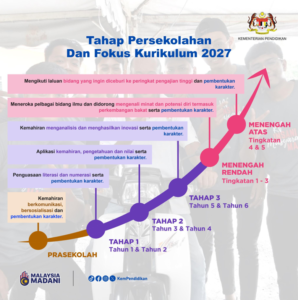
Source: Ministry of Education
What About Equity?
A key constraint in the current system is the uneven and limited supply of quality pre-school education. Without addressing this gap, policies around school entry risk disproportionately benefiting already-advantaged families, as they have the resources to increase their child’s readiness. However, this is true even without the lowering of the school entry age. From an equity perspective, lowering the entry age could benefit children and families who lack access to quality pre-school and rely on public education.
By bringing children into a more structured and regulated learning environment earlier, foundational learning can be delivered more equitably through the schooling system, which arguably has greater capacity to scale than the currently fragmented pre-school sector. Shifting responsibility for early learning into the public education system could therefore help reduce early learning gaps.
In addition, this reform is not occurring in isolation. The RMK-13 outlines efforts to strengthen the pre-school ecosystem, which includes the introduction of a national pre-school curriculum and the intention to lower the compulsory schooling age to five. The Ministry has also taken steps to improve pre-school quality by requiring teachers to hold diploma-level qualifications and expanding the number of public pre-schools.
Conclusion
Lowering the school entry age has the potential to strengthen foundational learning and close achievement gaps earlier, but only if it is implemented well. Malaysia’s experience with large-scale education reforms shows that ambition alone is not enough. Careful planning, adequate resourcing and sustained monitoring will be critical to ensure a smooth and equitable transition.
Ultimately, the success of this policy will hinge on both system readiness and how people respond to it. Clear and timely communication, alongside practical support for schools and families, will be essential to keep stakeholders aligned and to build trust. Without this, even well-intentioned reforms risk generating confusion and anxiety rather than confidence in the system.





One Comment