



A Quick Glance at RMK-13
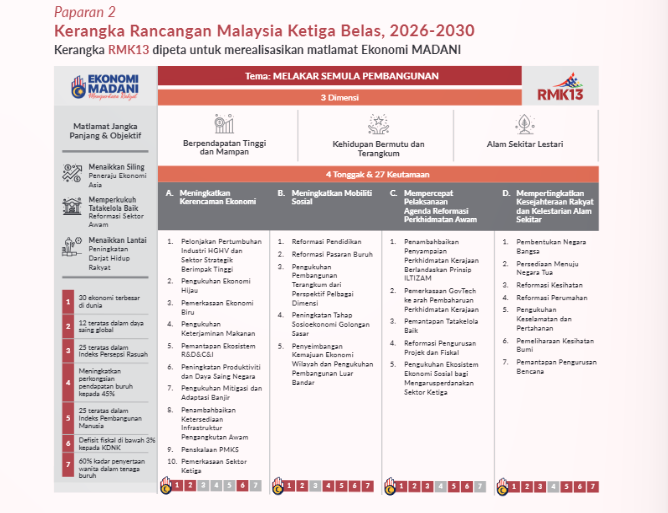
Overview of RMK-13
As we enter the most patriotic season of the year, with Merdeka and Hari Malaysia approaching, it is a moment to reflect on our nation’s progress and to look ahead. The 13th Malaysia Plan or Rancangan Malaysia Ke-13 (RMK-13) is Malaysia’s latest five-year development plan, covering 2026 to 2030. RMK-13 lays out the government’s vision and direction for nation-building that will shape Malaysia’s development in the coming years.
The theme for RMK-13, ‘Melakar Semula Pembangunan’ or ‘Reshaping Development,’ reflects the desire for socio-economic development that is more inclusive, sustainable and future-ready. Aligned with the Ekonomi MADANI framework, the plan is built around the vision to raise the ceiling, raise the floor and strengthen good governance.
RMK-13 sets out priorities across four main pillars, one of which is enhancing social mobility. Within this pillar, education reform is a key focus area, reaffirming education’s vital role as a social safety net that ‘raises the floor’ by improving living standards and reducing disparities, and as a key lever that ‘raises the ceiling’ by driving growth and upward mobility.
Let’s take a look at some of the education initiatives that have been outlined in the plan.
Key Education Initiatives in RMK-13
Eight strategies have been introduced under the education reform agenda. These strategies range from governance and efficiency initiatives to an emphasis on lifelong learning and TVET. In this article, we will focus mainly on two of the strategies, which are foundational to improve the quality of teaching and learning.
- Strategy 1: Strengthening Governance
- Strategy 2: Rationalising the Functions and Roles of Educational Institutions
- Strategy 3: Enhancing Educational Outcomes
- Strategy 4: Improving Learning Assessment and Evaluation
- Strategy 5: Strengthening Teacher Competence and Capability
- Strategy 6: Improving Educational Investment
- Strategy 7: Empowering Lifelong Learning
- Strategy 8: Strengthening the TVET Ecosystem
Enhancing Educational Outcomes
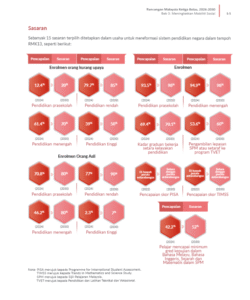
RMK-13 Education Reform Targets
This strategy shifts the emphasis from a narrow focus on access towards quality and outcomes-driven policies, which is both timely and necessary. The targets set for education signal a continued commitment to strengthening access across all levels of education, with particular emphasis on marginalised groups while positioning student performance measures such as PISA, TIMSS, and SPM results as indicators of progress.
A key initiative under this strategy is the introduction of compulsory preschool from the age of five, supported by a national preschool curriculum. This move reflects the recognition that learning gaps must be closed before children enter primary school to give every child an equitable headstart. Quality early childhood education supports language acquisition and the development of foundational skills that increase school readiness and set students up for success in their learning journey.
Looking abroad, there is encouraging evidence of what this approach can achieve and valuable lessons to consider. The Philippines introduced compulsory kindergarten in 2012, and evidence from SEA-PLM 2019 showed that children with early childhood education experience achieved higher test scores, were better prepared for school and were less likely to repeat grades. Yet, despite the policy, participation remained limited, with only 66% of five-year-olds enrolled in kindergarten by 2020. This highlights a crucial lesson: mandates alone are not enough, as key challenges such as preschool availability and quality remain significant bottlenecks.
Therefore, strong supplementary measures are needed to ensure both uptake and meaningful outcomes. In the short term, this would include identifying high-need areas for additional pre-school seats, easing licensing and renewal processes for unregistered centres, and increasing financial aid or incentives for parents and preschool operators.
While implementing a national preschool curriculum is a strong starting point to ensure consistent standards, its impact depends heavily on delivery. Investment in teacher training and professional development must also be made to ensure teaching quality keeps pace with the rising demand and supply for preschools.
At the same time, we must recognise that despite these efforts, some children will inevitably slip through the cracks. Hence, strengthening remedial interventions across different levels of schooling is critical to ensure no child is left behind. Initiatives such as the Program Kemahiran Asas Literasi dan Numerasi (KALIS) under Program Anak Kita, a collaboration between the Ministry of Education, Ministry of Finance, driven by Unit Pantau Madani, and Yayasan Hasanah must be continued to address any persistent literacy and numeracy gaps.
Strengthening Teacher Competence and Capability
A key factor that will determine the success of Malaysia’s education reforms is the quality of its teachers. Not only do effective teachers improve learning outcomes for all, but they also play a vital role in closing the gap between students of different backgrounds. Our best bet to break the cycle of education inequity and improve education outcomes for all is to elevate teaching quality. Therefore, we must build a strong pipeline of talent entering the public education system while strengthening the competence and capability of existing teachers.
RMK-13 aims to broaden teacher recruitment mechanisms to attract the best talent from multiple sources. This is a positive move as current pathways to enter the public education system are extremely limited. If implemented effectively, this initiative could diversify the teaching workforce, inject innovation into the system, and address the long-standing issue of teacher shortages. There will also be a study to assess the feasibility of cross-placement and mobility between different professions, to strengthen educator competencies and draw the best talent into the sector. While the exact mechanisms are yet to be outlined, we hope it will allow people from diverse educational and professional backgrounds to enter the system at different career points.
This exciting initiative could build on existing programmes. Teach For Malaysia’s Fellowship programme has demonstrated proof of concept by successfully attracting talent from top universities around the world and multinational corporations to serve in schools with the highest needs. It also reflects an important reality: career pathways are no longer linear. Whether driven by the call of nation-building, a career pivot, or a newfound passion for education, individuals are motivated by diverse reasons. If people with the right drive, commitment, and capabilities wish to serve in schools, whether for the short or long term, the system should make it a viable and attractive option.
Ultimately, whether teachers enter through traditional or alternative pathways, the selection process must also look beyond academic qualifications to consider their potential, capabilities, and commitment to driving student outcomes. In addition, RMK-13 highlights that teacher promotion pathways will be reviewed for a more competitive career progression on par with other professions, which would also be key to attract, retain, and reward our best talents. On top of that, we must also support teachers who are already in service by providing high-quality in-service training to keep them at the top of their game.
Another notable initiative in RMK-13 is the introduction of generalist teachers for core subjects in Year 1 and Year 2, where teachers will be trained and assigned to teach multiple subjects. This approach mirrors practices in countries such as the UK and Australia, where early primary teachers teach multiple subjects to the same sets of students. Adopting this model could help address teacher shortages, particularly in rural areas, increase flexibility with timetabling, and strengthen relationships with students. While operational and logistical considerations often drive the approach, evidence on its impact on learning outcomes is mixed. Therefore, rigorous studies and assessments would be needed to evaluate its impact in our context.
Conclusion
RMK-13 sets out a holistic agenda for education reform, balancing quality, equity, and systemic efficiency. While strategies focused on enhancing educational outcomes and teacher competence are central, strengthening governance and rationalising the functions of educational institutions play a crucial role in ensuring that policies are effectively implemented on the ground. Equally important is the emphasis on improving learning assessment and evaluation, including robust tracking mechanisms and feedback loops, to ensure that progress can be measured and timely adjustments can be made. Improving the way we make education investments is also key, as despite our high education spending, we have yet to see substantial improvements in educational outcomes.
Turning these strategic bets into meaningful outcomes will require collaboration among educators, policymakers, NGOs, and communities. While some initiatives are familiar, some are new and exciting, and their success will depend on well-designed policies and effective implementation. The upcoming Malaysian Education Blueprint 2026–2035 is anticipated to complement RMK-13 and further flesh out the details of these initiatives.
Have thoughts on RMK-13? Share them with us in the comments of our Instagram post!