



On 20th January, Prime Minister Datuk Seri Anwar Ibrahim announced a set of sweeping education reforms at the launch of the Rancangan Pendidikan Malaysia (RPM) 2026–2035 and the Rancangan Pendidikan Tinggi Malaysia (RPTM) 2026–2035. Together, these two plans form the Rancangan Pendidikan Negara (RPN), Malaysia’s overarching national education framework for the next decade.
Two specific announcements quickly captured national attention and public debate: the introduction of a new national assessment and the lowering of the entry age for Standard One. This article focuses on unpacking the first item, the Malaysian Learning Matrix.
Since the abolition of UPSR and PT3, questions around assessment have continued to feature in conversations on education in Malaysia. We have heard the call for a return of standardised examinations from politicians, parents and even students themselves. At the same time, there have been strong pushbacks against reviving high-stakes exams and the pressures they bring. The announcement of new national assessments in the form of the Learning Matrix (Matriks Pembelajaran) has reignited this debate with fresh fuel.
First Things First: What’s the Status Quo?

In Malaysia, assessment is often narrowly understood as examinations. This limited understanding has shaped how assessments are perceived and used across the system. At its core, assessment is a tool to understand student progress and serves three broad purposes: assessment of learning (to measure achievement), assessment for learning (to inform teaching and learning), and assessment as learning (where students actively reflect and take ownership of their learning).
Our education system has historically leaned heavily on assessment of learning, focusing on scores, grades, and rankings from summative assessments. Following the abolition of UPSR and PT3, the shift towards school-based assessments was a bold and progressive move. However, the system and its stakeholders were not fully ready for this transition. Teachers were not sufficiently trained to adopt the new approach, quality assurance mechanisms were weak, and issues around data reliability and accuracy persisted. As a result, confidence in school-based assessments eroded, with persistent concerns around consistency, credibility and comparability.
Furthermore, despite the shift, assessment for learning and as learning were still not common practices. Often, school-based assessments such as the Ujian Akhir Sesi Akademik and classroom-based assessments are not utilised to inform targeted interventions. Meanwhile,gaps in student learning remain unaddressed as they progress to the following year.
What Do We Know So Far?
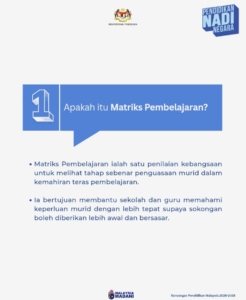
The Learning Matrix is a new national assessment administered by Lembaga Peperiksaan for Year 4 and Form 3 students. Year 4 students will sit the first assessment in October 2026, covering Bahasa Melayu, English, Mathematics, and Science, with the primary goal of informing learning interventions and supporting the implementation of the new curriculum. Form 3 students will be assessed starting in 2027, covering the same subjects along with History, to gauge achievement and guide decisions on upper secondary pathways. Click sini for the FAQ issued by the Ministry of Education.
The introduction of the Learning Matrix appears to chart a middle path. It restores a degree of national oversight and quality assurance, helping to rebuild confidence in the system, while retaining school-based assessments. So far, the assessments have been designed and communicated with the intention of keeping them low-stakes. For example, the Year 4 assessment acts as a diagnostic checkpoint to surface learning gaps early, allowing teachers and schools a two-year window to provide targeted interventions before students enter secondary school.
A useful way to view the Learning Matrix is as a routine health check for learning, much like a medical check-up. We don’t typically prepare intensively for a medical check-up, as its purpose is to monitor progress and detect issues early, so that appropriate interventions can be put in place if needed. Similarly, the Learning Matrix is designed to provide a clear picture of a student’s learning health based on usual teaching and learning activities to highlight strengths and pinpoint areas for targeted support. Therefore, the success of the Learning Matrix depends not only on the assessment itself but also on how it is used. Teachers must adopt a data-driven approach, working collaboratively to plan interventions and customise learning. In addition, strengthening school- and class-based assessments remains critical. Assessment should always serve learning, not the other way around.
Mindset and Culture: Why Does It Matter?

The success of any education reform depends not only on the policy itself, but also on how people respond to it. Parents, teachers, students, and the wider public all play a role in shaping how an assessment is experienced and whether it achieves its intended purpose. If the Learning Matrix is treated as a high-stakes exam, then it will become one, and its value in supporting learning, identifying gaps and guiding targeted interventions will be lost.
For the Learning Matrix to achieve its purpose, teachers must adopt a data-driven approach, working collaboratively to plan interventions and customise learning. At the same time, it is crucial to align mindsets and expectations across all stakeholders. Clear communication, parental education, and teacher capacity-building are essential to ensure that the assessment supports learning rather than creates unintended pressures.
This is where collective responsibility comes in: the Ministry, schools, teachers, parents, and the public all have a part to play in ensuring that reforms do not drift into unintended territory or get misinterpreted. It also involves how teachers are trained, how school performance is assessed, and how implicit pressures and potential consequences are managed.
Collective Leadership: The Missing Piece

“To transform education we need system change, not just reform.”
The Missing Piece Report: Developing Collective Leadership to Transform Education, Teach For All
Reforms often target visible parts of a system, such as policies, practices, structures, metrics, and resource flows. These are necessary technical solutions. However, real transformation requires shifts in mindsets, relationships and power dynamics. When these underlying conditions remain unchanged, it often holds the problem in place, and even well-designed reforms can struggle to achieve lasting impact. True system transformation requires investing in both policy and people. Each reinforces the other, creating the conditions for meaningful and sustainable change.
At Teach For Malaysia, we cultivate collective leadership by bringing diverse individuals together to learn, collaborate, and grow as empowered changemakers and nation-builders. We are looking for passionate and purpose-driven Malaysians to join our 15th Fellowship Cohort. The Teach For Malaysia Fellowship is a full-time, fully paid two-year Leadership Development Programme, designed to equip aspiring leaders with the skills, on-the-ground experience, and network to create long-term change in classrooms, communities, and the education system. Applications for the Teach For Malaysia Fellowship are now open. Apply at: teachformalaysia.org/fellowship.
- Read our earlier article for a full breakdown of the Rancangan Pendidikan Malaysia 2026–2035.
- Explore more Ed Pulse articles sini.