

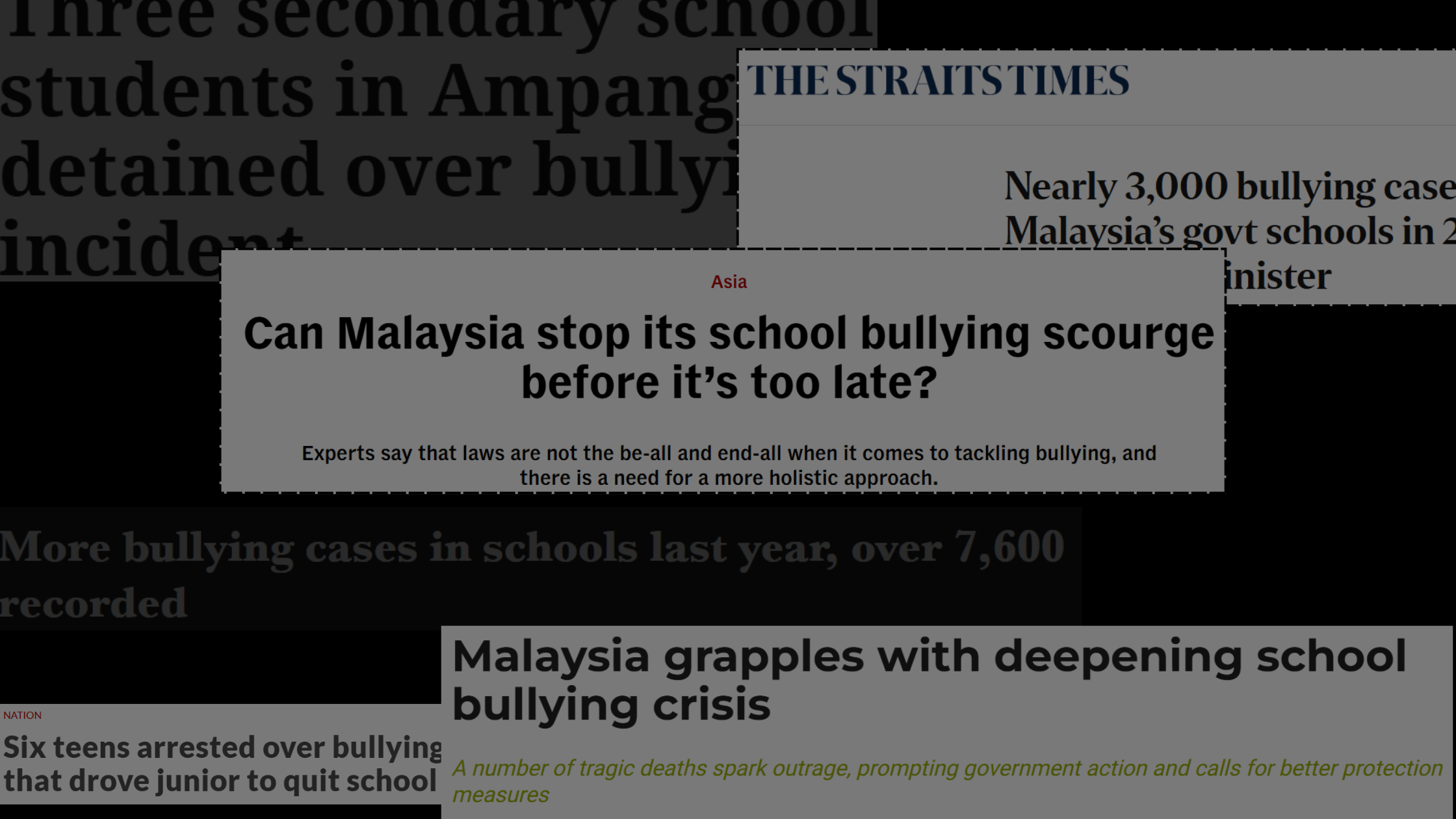
For many years, bullying has largely been viewed as a school discipline issue that is handled internally by teachers and school administrators. However, rising reports of bullying, increasing recognition of the long-term harm experienced by children, alongside growing public concern, have pointed to the need for a stronger framework and a more coordinated approach. The Anti-Bully Act 2026 represents the country’s first dedicated legal framework to prevent and respond to bullying involving children.
Why Malaysia Needed the Anti-Bully Act
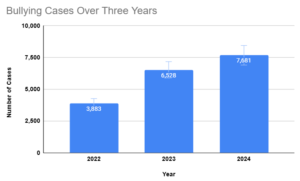 The Ministry of Education’s Student Discipline System (SSDM) recorded a steady rise in bullying cases over the past three years — from 3,883 in 2022 to 6,528 in 2023 to 7,681 in 2024. More than 70% of these incidents took place in secondary schools. Meanwhile, the 2022 National Health and Morbidity Survey (NHMS), involving more than 33,000 adolescents aged 13 to 17, found that 8.6% of adolescents reported having been bullied. Some of the most common forms of bullying included being mocked about their appearance (26.7%), experiencing sexual jokes or gestures (16%), being deliberately excluded or ignored by peers (13%), and being bullied because of race, nationality or skin colour (11.7%). The rise in bullying incidents, alongside growing concerns about cyberbullying, highlights why this issue has become a matter of public concern.
Until now, Malaysia has largely addressed bullying cases through existing school disciplinary processes, supported by criminal and civil laws where applicable. However, these approaches may not always be enough to address the full range and complexity of bullying cases, particularly when incidents occur beyond school settings or require additional support and intervention. This is reflected in an Ipsos poll on bullying in 2025, which found that 72% of school bullying victims did not take any action. Common barriers to reporting and seeking help include fear of retaliation, lack of trust in the process, concerns that complaints may not be handled appropriately and difficulties in providing sufficient evidence.
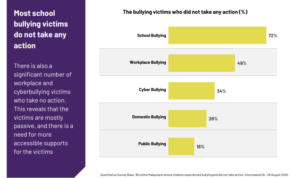
Credit: IPSOS PRESS RELEASE: BULLYING IN MALAYSIA
Against this backdrop, the Anti-Bully Act 2026 reflects a shift towards recognising bullying as a wider societal and child-protection concern that requires clearer responsibilities, stronger accountability and coordinated action across schools, families, communities, and institutions. It also sends a clear message that bullying should not be normalised or tolerated.
Key Features of the Anti-Bully Act 2026
The Anti-Bully Act 2026 introduces new measures to strengthen the prevention and resolution of bullying cases. It applies to children under the age of 18, students enrolled in educational institutions including tahfiz schools, Majlis Amanah Rakyat (MARA) institutions, Henry Gurney Schools, and certain institutions established under the Child Act 2001. The Act is not limited to incidents that occur within school grounds. Bullying involving a child victim may still fall within the Act even if it takes place outside the supervision or monitoring of an educational institution. While the legislation touches on many areas, three key features are particularly important.
1. A broader shared understanding of bullying
The Anti-Bully Act 2026 broadens and promotes a shared understanding of bullying by recognising that harm can take many forms and that even a single serious incident may constitute bullying.
“Bully means any wilful act and directed at a victim by any means, whether committed repeatedly or in a single severe incident which cause physical, psychological or social harm to the victim.”
The Act further recognises the different forms of bullying and the wider impact it can have on children. These include:
- Physical harm — such as acts that cause injury or damage to a victim’s belongings.
- Verbal harm — including words or threats that abuse, demean, or negatively affect a victim’s psychological well-being.
- Social harm — such as deliberately excluding someone, damaging their reputation, or creating a hostile environment.
- Discrimination or humiliation — including acts targeting someone because of their sex, race, religion, or disability.
- Online bullying — where harmful words, exclusion, threats, or discriminatory behaviour take place through electronic or digital communication.
This matters because many forms of bullying are not always visible and can be overlooked or minimised. Recognising these different forms of harm helps ensure that children’s experiences are taken seriously and addressed appropriately.
2. Clearer duties and accountability for schools to address bullying
The Anti-Bully Act 2026 provides clearer duties and structures to strengthen the way schools fulfil their responsibility to prevent, manage, and address bullying cases. A key requirement is the establishment of a Committee for the Prevention and Management of Bullying Cases within educational institutions. The committee is responsible for supporting schools in managing complaints and cases including, advising on appropriate responses and facilitating mediation between parties where possible.
The Act also outlines expectations for schools to implement anti-bullying policies and procedures; provide accessible, child-friendly reporting channels; provide counselling services and psychosocial support; equip staff with relevant training to prevent and manage bullying cases; and comply with standards set by the Ministry. The Act formalises these responsibilities and promotes a whole-school approach where roles, processes, and accountability are outlined to create safer learning environments.
3. The Tribunal for Anti-Bullying

Credit: https://tab.bheuu.gov.my/
The most significant and progressive features of the Act is the establishment of the Tribunal for Anti-Bullying, a platform to address bullying cases that is designed to be accessible, child-friendly, and free of charge. Complaints may be lodged by the victim or, where the victim is a child, by the child’s parent or guardian.
For many school-related cases, complaints are expected to first go through the school’s Committee for the Prevention and Management of Bullying Cases. The Tribunal serves as an escalation mechanism when a complainant is dissatisfied with the outcome, where no action has been taken, or where the complaint has not been handled appropriately. Where the victim is a child and the incident occurs outside the supervision of an educational institution, a complaint may also be brought directly before the Tribunal. If the incident involves a criminal offence, a police report may still be lodged.
Unlike criminal courts, the Tribunal provides a simpler, faster, and more child-friendly avenue for resolving bullying complaints. Tribunal hearings are conducted in private to safeguard confidentiality, and the identities of children involved are protected from public disclosure. Child complainants are entitled to be accompanied by a parent or guardian, and where appropriate, disputes may first be resolved through mediation, provided both parties give informed consent. Legal representation is generally not required, although lawyers may be permitted in limited circumstances involving complex legal matters.
Depending on the circumstances of each case, the Tribunal may issue a range of remedies aimed at both accountability and recovery. These may include requiring an apology, ordering the removal of harmful online content, reimbursement of expenses, compensation for losses suffered, participation in rehabilitation programmes, or counselling and parenting support where appropriate.
Complaints can be submitted through the Tribunal for Anti-Bullying’s official portal, which provides relevant forms, guidelines, and frequently asked questions. For victims and their families, this provides a clearer pathway to seek help when existing processes fall short.
From Legislation to Lasting Change
The Anti-Bully Act 2026 marks an important milestone in strengthening child protection in Malaysia. However, legislation alone will not end bullying. Bullying rarely begins and ends in the classroom. It reflects wider attitudes, behaviours and relationships that children experience at home, online and in their communities. Preventing bullying is a shared responsibility that requires collective action from schools, families, communities, policymakers, and children themselves. While clear and accessible complaint and resolution mechanisms are important, lasting change begins much earlier by nurturing values of empathy, respect, kindness, and inclusion. This requires adults to model these values in their own words and actions, while helping children develop the social and emotional skills to build healthy relationships and resolve conflicts in a positive manner.
The Act’s greatest success will not be measured by how many cases are resolved by the Tribunal, but by the number of bullying incidents that never require its intervention. Achieving this will require sustained efforts to educate children, parents, educators, and the wider community about recognising bullying, responding appropriately, and creating environments where children feel safe to speak up for themselves and for others.
Need Support or Someone to Talk To?
If you, your child, or someone you know is experiencing bullying, feeling overwhelmed, or needs someone to talk to, resources and support are available.
Buddy Bear Helpline
A free and confidential emotional support helpline for children and teenagers in Malaysia aged 6 to 18 to talk about their worries, feelings, or challenges.
📞 1800 18 2327
💬 Facebook Messenger
Befrienders Malaysia
A free and confidential helpline providing emotional support for individuals experiencing distress, loneliness, or who need someone to talk to.
📞 03-7627 2929
Talian HEAL 15555
A toll-free mental health support line providing assistance for individuals experiencing emotional distress or mental health concerns.
📞 15555
Talian Kasih 15999
A toll-free, 24-hour helpline providing support and assistance for children, families, and vulnerable groups facing social issues, abuse, or crises.
📞 15999
💬 WhatsApp: 019-261 5999
📱 Talian Kasih App